26 November 2007

Take THAT Blue Cross Blue Shield!

As many of you know, one of my fondest pastimes is to write angry letters to companies that I feel have slighted me either knowingly or (most frequently) unknowingly. So here is the latest installment, a scathing, tongue-in-cheek tirade targeted at the Blue Cross Blue Shield website, where I recently went to manage my Dental plan...
<THE SIMPSONS>DENTAL PLAN! (Lisa needs braces...)
DENTAL PLAN! (Lisa needs braces..)...</THE SIMPSONS>
So I can get a quote for Dental Blue, apply for it, and sign up for it online, but it takes a star sighting, a Ouija board, and Dionne Warwick to figure out how to manage my dental plan online???

Either implement this functionality please, or else if it's there, for the love of god and sunday Jesus make it more accessible!

And then the customer service line only keeps bankers hours? Wtf guys? With what I pay for dental, I should be able to call Mr. Blue Cross or Ms. Blue Shield and have them amend my plan personally. Good day, sir! I SAID GOOD DAY!

All due credit to a poster on thewolfweb, from whom I took the best bits -- the bit about the star sighting and the bit about god and Sunday Jesus.

23 October 2007

A funny voicemail I received

Hhhhhhhhhhhey, its mmmme. Just seein what you were doinnnnnnn.

Yeah, got my Medicaid card today... it was like Christmas. Hah. Now I gotta get these fucked up teeth fixed.

But yeah, I've left you a bunch of messages, and you still havent called me back so maybe if i keep leaving them you'll eventually answer the phone.
An actual, real voicemail I got a month ago. It was a wrong number obviously, and it sounded like a twenty-something girl. It works best if you hear it in your head with inflections similar to Peter Griffin in the episode, "I am Peter, hear me roar."

Oh, and it was a 252 area code.

01 October 2007

Radiohead Pulls Pincer Move; USD Approaches Five-Year Low vs. GBP

In a move that blindsided both the world and also music industry insiders, Radiohead announced today that its seventh LP, In Rainbows, would release on 10 October 2007.

In other words: next week.

i.e. - no promo material.

c.f. - available for purchase online only.

n.b. - purchase is optional.

Their fulfillment of contract (via Hail to the Thief) to release six full-length albums with EMI, combined with their dismissal of any contract renewals with the megacorporation, led to widespread assumption that the mega-band's long-anticipated (and purportedly twice-composed) seventh album would be released independently.

These assumptions were solidified into common knowledge upon the release of frontman Thom Yorke's solo album on the (then-)miniscule label, XL Recordings. But nobody (perhaps not even the band members themselves) foresaw the album releasing like this. Time is reporting that the decision
to launch a global, simultaneous, donations-only release of the album was made only several weeks ago.

To clarify: In Rainbows will be available for download starting next Tuesday, 10 October (presumably 12:00:00 GMT?). A separate "discbox" collection is also available for ₤40, which includes the digital download on or after 10 Oct 2007, along with a copy of the CD, a 2xLP (in heavyweight 12" vinyl), and accompanying books and artwork which will ship on or before 3 Dec 2007. The discbox collections are made to order, which you should essentially read as "made per order" since they aren't customisable, really. Even employees at w.a.s.t.e. and nasty have to order their own discboxes. Absolutely no promo materials available.

But if you just want to download the album, you have two options:
  1. You can pay for the downloads.
  2. You can download for free.
You can pay $1000 for each song, if you happen to have that kind of "fuck everyone" money laying about. Or if you're broke but still absolutely feel an ardent need to pay for the music, then you can pay just a penny for the whole album--what exchanges to "ha'pence," or half a penny in British Pounds.

Shit Ha'pence.

And of course this segues into the economic effect such a move has. Though my title misleads one to believe the US Dollar approached a five-year low against the British Pound as a result of Radiohead's announcement, that's really only true in my head.

As a maniacal Radiohead fan, the free download aspect of the album release is novel and laudable, but not to purchase the CD/LP set--well, clearly it's not even an option for me.


(Five year trend of USD to GBP.)


(Last five days - USD to GBP.)

See, the US Dollar approaching a five-year low means that I'm paying US$81 for the ₤40 discbox, whereas ten years ago I would have paid, say, US$70 when the exchange rate was perhaps 0.600 GBP per 1.00 USD. (The exchange rate at the close of market Monday was 0.4899 GBP for 1.00 USD, fyi.)

So anyways, that was my rant about the exchange rate. Onto the less miserly point of economic interest in the matter: the impact on the music industry as a whole. While industry executives will surely downplay the effect such a move will have (in the same way that a rabid fan like myself will overplay the same effect), there is surely some middle ground between their underestimation and my overestimation.

Surprisingly, I think that middle ground is best stated in a quote from an A&R exec in the aforementioned Time article:
"This feels like yet another death knell," emailed an A&R executive at a major European label. "If the best band in the world doesn't want a part of us, I'm not sure what's left for this business."

28 August 2007

omg it's almost time (Somebody set up us teh bomb!!1!)

Um, holy shit... so the most wonderful time of the year, college football season, starts in like 48 hours from now.

I'm ready for another season of BCS bitching, NC State heartbreaking games, and crazy amazing games like last year's BCS butt-fugg, Boise State pwning Oklahoma in the Fiesta Bowl.


Ahh... I can almost feel the belligerence already...

22 August 2007

Pan’s Labyrinth: a Review

Guillermo del Toro’s mélange of genres, imagery, and ideologies in Pan’s Labyrinth could be set no better than in Spain, a country whose own mix of genres, imagery, and ideologies has few other peers. Against the backdrop of the Spanish Civil War, this “fairy tale for adults” is immersive and unexpectedly captivating. The imagery of Spain (not to mention the rest of the world) at war with itself is set against a fable world of fauns, insects-turned-fairies, and other nether-creatures which, under the direction of perhaps any other writer/director, would become a beautiful world to contrast the ugliness of the “real” world.

But del Toro’s fable world is as dark (literally and figuratively) and disturbing as the world little Ofelia flees—the violence of Europe’s ideological upheavals reflected in the sinister and grotesque characters Ofelia finds in the fable world. Even “Pan” (el Fauno) of the title, who is supposed to be on the side of the would-be princess, Ofelia, creates a staggering amount of doubt whether his intentions are benevolent or not. Del Toro, rather than showing the trite “two sides of the same coin” instead chooses to show the same side of two different coins, or perhaps more accurately: the same two sides of the same single coin.

And as you may be used to my fixation on conclusions by now, del Toro takes the artistic and therefore honorable route (or is that the other way around? Or does it matter?) Rather than the ending everyone expects—that is, the girl escapes the horrors of the “real” world into a chimeric world in which she is the prophesied and long-awaited ruler—del Toro instead brings the two story lines together, stumbling and mortal, into an ending where failure is success and suicide is sacrifice—and the contrapositive of both is also true.

The ending also combines the imageries and ideologies of communism with its antithesis, Catholicism. The Trinity—found in every excursion Ofelia must endure through the fable world—manifests itself in the royal court, where Ofelia’s always present/always absent (f/F)ather occupies the slightly elevated central chair, while her birth mother occupies the chair on the left. In every trinity in the movie, the character always turns left, as if the overt and graphic violence of the right-wing fascist militarism throughout the movie isn’t enough to cause one to lean left. However, in all fairness, when the communist “army” overpowers the fascist cavalry—and is there a hidden Calvary reference in there?—from the left hand side of the screen, one still feels uncomfortable to see the communist “heroes” engaging in the same murderous violence we see from the Fascists throughout the film. Again, the same two sides of the same single coin.

But wherever this half-drunken analysis has led to, the overall impression of the movie I’d like to end with is that this is a tour de force that ruthlessly undermines Hollywood’s new paradigmatic regurgitation. The best movie I’ve seen in quite a long time.

Add it to your netflix.

05 August 2007

"Dude, you're getting a Smell!"

So in one of the bigger impulse purchases I've ever made, I bought a Dell tonight. What with the new job, new income, and most importantly, the tax-free weekend, I just gave in something fierce.

Dell Inspiron 531:
AMD Athlon™ 64 X2 Dual-Core 4400+
Genuine Windows Vista® Home Premium
1GB Dual Channel DDR2 SDRAM at 667MHz
160GB Serial ATA Hard Drive (7200RPM)
48X CD-RW/ DVD Combo Drive
256MB NVIDIA GeForce 8600GT-DDR3
Integrated 7.1 Channel Audio


I looked at Lenovo, but even with my Dad's discount, it was cheaper for me to go with Dell for comparable builds. So what if it's a Dell, and so what if it has Vista on it? In the end, it was cheaper than me building one, even though I really wanted to do.

And this way the old Aptiva is going to become a Linux "p0w3rh4us." Which I'm really going to enjoy playing around with. The next decision seems to be: which flavor of Linux should I go with?

04 August 2007

The Comedy Central Roast of Flavor Flav

So... what? Any asshole can get roasted now?

I was never quite sure the point of "roasts," or what qualified one for roasting, for that matter.

But Flavor Flav?

Really
?

Coming December 2007: The Comedy Central Roast of Bobby B? Come on, now.


And while we're on the subject of worthless nobodies, who is LonelyGirl15 and why can't I escape the myspace marketing campaign for her? I've already adblocked like 2 or 3 images supporting that campaign, and it's like they know I'm doing it and keep posting more just to fox with me.

02 August 2007

"And you, too, shrink slowly backwards..."

I miss Prague.

Especially lately. And for whatever reason. Perhaps because my new job means my recently-acquired life long dream of moving to Prague is deferred, indefinitely. Perhaps I really should stop looking through my photos of Prague. The night shots get me the most.


(Hradčany, street level from Charles Bridge.)

The hands of the clock in the Jewish Quarter run backwards
And you, too, shrink slowly backwards through your own life
Climbing Hradčany and in the evening listening—
In the pubs they are singing Czech songs... (Apollinaire)

Hradčany is the district in Prague 1—"Lesser Prague"—upon which Prague Castle rests, its cobblestone streets tightly winding uphill to castle summit.


(Hradčany, peaked by Prague Castle, from Staré Město.)

I'm convinced there can't possibly exist another city in the world like Prague in the dead of night. Everything at night seems to exist as though in a golden, half-lit fable.


There's a feeling in my memory of a clock spring wound too tightly, of potential energy on the verge of kinetic release.

A gravity on the icy edge of inertia.

I don't know if it's Kafka, or Susannah, or just Prague.


The strange text resembling English.

The woman's voice announcing stops on the subway, like a record playing backwards:

Star-oh-mgyes-ka
...

Myooz-tek
...

Moosziam...

Eeee-Pay--pAHvlova...

...

...

30 July 2007

On a more serious note... (or, "It's fuckin on!")

So my posts have tended to be pretty serious, analytical, and academic since I moved my blog from myspace to blogspot. And on myspace, the blogs weren't always so... boring. Often, yes, they were. But anyhow, look at me: I'm trying to not make a boring, analytical post and I can't help myself from analyzing it.

So here's what's fuckin on, peoples!!


Diagram for copper drain manifold for the mash tun.


The (soon-to-be) mash tun.


Drainage flow gradient (from How To Brew by John Palmer)


All of this inspired by the very sufficient site, FreeBrewingVideos.com

23 July 2007

City Lights (Stranger Than Fiction revisited. Again.)

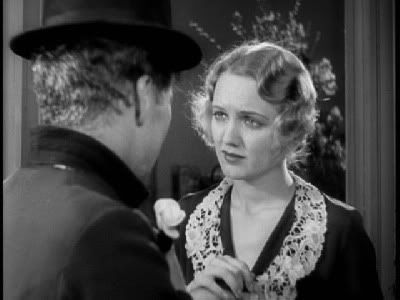
If you've been reading my blog, you know that I've recently developed a fixation on the movie Stranger Than Fiction and what I consider to be its terribly formulaic ending. I had an AIM chat with JB about it, which I wish I'd saved because he made some good points in favor of Stranger Than Fiction. But in lieu of that, I want to take a look at a movie with what I consider to be a great ending, and that is Charlie Chaplin's last silent film, City Lights (1931). I know this film through Žižek's analysis of it in Enjoy Your Symptom! and this post largely will be a regurgitation of it. I'll quote his synopsis of the movie so you have a grasp on what's going on:

City Lights is a story about a tramp's love for a blind girl selling flowers on a busy street who mistakes him for a rich man. Through a series of adventures with an eccentric millionaire who, when drunk, treats the tramp extremely kindly, but when sober fails even to recognize him . . . , the tramp gets his hands on the money needed for an operation to restore the poor girl’s sight; whereupon he is arrested for theft and sentenced to prison. After he has done his time, he wanders around the city, alone and desolate; suddenly, he comes across a florist’s shop where he sees the girl. The operation was successful and she now runs a thriving business, but still awaits the Prince Charming of her dreams, whose chivalrous gift enabled her sight to be restored. . . . The tramp immediately recognizes her, whereas she doesn’t recognize him, because all she knows of him is his voice and the touch of his hand: all she sees through the window (separating them like a screen) is the ridiculous figure of a tramp, a social outcast. Upon seeing him lose his rose (a souvenir of her), she nevertheless takes pity on him, his passionate and desperate gaze stirs her compassion; so, not knowing who or what awaits her, still in a cheerful and ironic mood . . . , she steps out on the pavement, gives him a new rose and presses a coin into his hand. At this precise moment, as their hands meet, she finally recognizes him by his touch. She is immediately sobered and asks him: “You?” The tramp nods and, pointing to her eyes, asks her: “You can see now?” The girl answers: “Yes, I can see now”; the film then cuts to a medium close-up of the tramp, his eyes filled with dread and hope, smiling shyly, uncertain what the girl’s reaction will be, satisfied and at the same time insecure at being so totally exposed to her—and this is the end of the movie.
Žižek begins his discussion of City Lights by claiming that no other film in the history of Hollywood has relied more upon its final scene than City Lights. And again, I think where Stranger Than Fiction fails is that it similarly wagers the entire film on the final scene, and it fails. I would even say it ups the ante by including in the diegesis of the film this intense focus and pressure upon the final scene, and, completely unable to support the weight of the entire film multiplied by the diegetic focus on its conclusion, the conclusion crumbles in on itself. Once this happens, the film feels tainted, like you can almost see the Hollywood-types rushing in to mash the pieces back together into something recognizable. Disheartingly, that "something recognizable" is the typical and unfortunate "happy ending" to any run of the mill romantic comedy.

City Lights proclaims itself to be a romantic comedy in its opening credits. And even then—1931, with the silent era closing with the "traumatic intrusion of the voice," to paraphrase Žižek—even then they avoided the trap into which Stranger Than Fiction writes itself.


(In this shot, Chaplin conveys the tramp's delight at seeing the girl again juxtaposed against his anxiety and recalcitrance that the girl may discover who he really is.)


(After the girl pushes the coin into his hands and realizes that her wealthy knight in shining armor is realized in this pathetic figure of the tramp, her expression is as priceless as it is complicated—recognition, pity, compassion, gratitude, and so much more. But certainly not elation, acceptance, anticipation.)


(The final shot which fades to black.)

Even then, in 1931, the genius of Chaplin completely destroys Stranger Than Fiction. If you write a screenplay that stakes the entire film on the final scene, don't confuse an ending with a conclusion. In City Lights, the conclusion of the story lies beyond the diegetic end of the film, the fade to black. What allows Chaplin to stake everything on the final scene and to succeed wildly doing so is that he concludes without conclusion and thus avoids denouement and the classic narrative dichotomy: tragedies end in death, comedies end in marriage. Stranger Than Fiction has the audacity to stake it all on the conclusion, but is not brave enough to avoid denouement.

19 July 2007

Are you beautiful? Solve for x.

I watched the majority of a program on PBS yesterday (hosted by John Cleese of Monty Python fame) called "The Human Face with John Cleese," and the topic of this installment was "Beauty."

I stumbled onto the program 15 minutes or so into it, but it's clear that they were trying to demystify (or better yet: universalize, or perhaps most accurate: generalize) a concept of human beauty.

What made me stop as I flipped through was a photo array featuring faces ranging from the gorgeous to these hideously deformed faces you see in lepers and "elephant-man" types. But this was old hat to me—concepts of human beauty are limbically associated with physical symmetry, particularly of the face, because higher degrees of symmetry suggest (again, this is on a limbic level) better health and by extension, better reproductive viability.

But what really piqued my interest was that some researchers (there was an evolutionary psychologist, a "reconstructive" surgeon, and other professional types) speculate on a mathematical foundation to "universal" concepts of beauty. And to my absolute shock, it was my favorite number, phi or φ or 1.6180339...

For those of you unfamiliar with φ, I'll try not to bore you and thus simply say it is a number which has come to be known as "the Golden Number" or "the Divine Ratio." It is a number found throughout nature, as well as pop culture manifestations in the movie Pi (perhaps the most inappropriately named movie of all time, after Final Destination: 2). If you want to know more about φ, the actual number, I'll offer a little more background at the end of this post.

What's important for the discussion of beauty and the assertion of a mathematical formula for human beauty is that this number is purported to be a "visual harmonic" (if I may be so fast and loose with the terminology). In the same way that a harmonic is achieved on guitar by plucking a string at a natural node according to the wavelength of the string, some purport that φ is some harmonic point resting at a "visual node" of some ocular wavelength (not to be confused with the wavelengths of light itself).

What all that basically means is that objects displaying this ratio seem most visually appealing, most pleasing to the eye. (This assertion itself is the subject of much debate, and rightfully so as it's the result of Renaissance-era Neoplatonism.) The most common assertion of this is found in the "Golden Rectangle." (Some believe that the Parthenon in Athens is such a rectangle.) A golden rectangle is one whose sides form the ratio of 1.618:1. Below is a rectangle with a height of 1 and a width of 1.618...
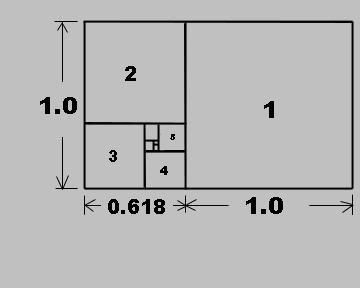


What makes the rectangle so "golden" or "divine" is that these proportions can be used to create infinitely many congruent rectangles inside of it:


(The congruent rectangles can be made by removing the square from the main rectangle, the secondary rectangle, and so forth.)

THE NITTY GRITTY: 1.618...

The assertion of Dr. Stephen Marquardt (who, to my distress though not my surprise, is a SoCal native and "reconstructive" [read: plastic] surgeon) is that the faces of "beautiful people" follow certain geometric ratios. For instance: the width of the mouth to the width of the nose is 1.618:1. The width of the secondary incisor to the primary incisor is 1.618:1. An exaggerated and erroneous depiction of all these golden ratios that may be found in the human face follows:
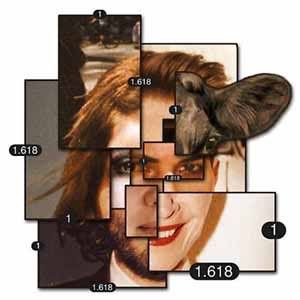

(No idea what the cattle head is doing in that collage.)

Furthermore, Dr. Marquardt stated that the ratio of φ exists throughout the human body as well. In "well-proportioned" people, the ratio of their overall height to the height of their belly button is 1.618:1. On the phalanges of the fingers: the ratio of the length of the first phalange to the second is 1.618:1, and the second to third, 1.618:1. (I presume this assertion carries across all the fingers, and it's not clear to me whether he meant that this is a universal human ratio, or only one found in aforementioned "well-proportioned" people.)


(Artist's rendering of the possibility of golden ratios on the human body.)

And while the motivations of Dr. Marquardt obviously go beyond the narcissistic, obsessive-neurotic motivations of all academics (including yours truly), what is difficult to dismiss is that this φ is a number found throughout nature: φ is the reason why four-leafed clovers are relatively rare. See, 4 is not a Fibonacci number. (It is at this point that I am forced to delve into the background of φ and of course some mathematical specifics.

The Italian mathematician, Fibonacci, noticed that—in nature—numbers belonging to a specific sequence of numbers appear far more frequently than numbers not in this sequence. (I think he noticed this while breeding rabbits? Something along those lines... google it if you're curious.) This sequence of numbers has subsequently come to be known as "the Fibonacci sequence" or "Fibonacci numbers." The general formula for any given number in the sequence is to simply add the previous two numbers in the sequence. And the sequence starts with 0 and 1. Thus:

Fn = Fn-1 + Fn-2 (any given number in the sequence [Fn] is simply the sum of the previous two numbers [Fn-1 + Fn-2])


The first few numbers in the series are thus:

0, 1, 1, 2, 3, 5, 8, 13, 21, 34, 55, 89, ...


Notice that 4 is not in the sequence. That is what makes 4-leafed clover so rare: 4 is not a "natural harmonic." (Again, I'm being fast and loose with the terminology.)

Now, if you divide any number in the sequence by the number before it, the result approaches the number, φ, 1.618...

1/0 =
1/1 = 1
2/1 = 2
3/2 = 1.5
5/3 = 1.666...
8/5 = 1.6
13/8 = 1.625
21/13 = 1.615

Notice how the result of these divisions keeps getting closer to φ, to 1.618.... ?

What I find even more interesting is that mathematicians claim that φ is the most irrational number, even more irrational than the most famous irrational, π, 3.14... . And perhaps it makes it more difficult to belive (or easier, depending on your own philosophy) that the most irrational number stems from a most straightforward equation. To approximate φ, simply repeat this formula for as long as you have the stamina:


(Shoutout to all the ThinkPad peeps... whut whut!!)

OR:


phi = 1 + 1
-----------
1 + 1
------
1 + 1
------
1 + etc.


And I believe it's at this point that I will end my analysis. Beauty and irrational numbers, physical attraction and φ's prominence throughout nature... this all feels like it's verging on some sort of limit of its own, or better yet: a divergence. As a recovering atheist, I can't allow myself to say it, but as an agnostic I'm confident leaving it at: There's something serious going on here—something foundational, something structural.

13 July 2007

Poykpac pwnts Stranger Than Fiction (or: Why I Dislike Most Movies, redux)

So as I asserted in my last post, Stranger Than Fiction fell short for me in the sense that it attempts to be a comedy (it doesn't end in the hero's death), a postmodernist film (the reflexive analysis of the role of non-diegetic narrative), and a romance (Click and Pascal end up together, despite ideological differences).

What I'd like to show in this post is a film that is a relevant and contiguous postmodernist comedy. (If you didn't already know, or if you'll scroll down to the previous post, you'd know that my beef with Stranger Than Fiction was not the movie as a whole, but the concluding 15 minutes in which the movie deteriorates into the same old Hollywood crap.) In the short film, "Diegesis," by Poykpac (a comedy troop located in Brooklyn, featuring two Millbrook alumni—Dave Powell [not featured] and Jonny Gillette [the brilliantly portrayed Orlando]), they offer a short that is comedic, postmodern, and contiguous (that is—self-cohesive from start to finish, i.e. where Stranger Than Fiction fails.)


See for yourselves:

DIEGESIS: A Film


If you're gonna go postmodernist, then do it with all the reflexivity, absurdity, and lightness that entails.

12 July 2007

Stranger Than Fiction (or: Why I Dislike So Many Movies)

So as some of you know, I tried to get a group together to see Will Ferrell in Stranger Than Fiction when the NC Museum of Art played it outside on Friday, June 29. But it was rained out, which is only natural because it was one of the only movies they're showing this year that I was interested in seeing.


So instead, I just put it in queue on my netflix, and oddly enough, it came today. (I want to say that it hasn't rained since the 29th, but I can't be sure.) So I watched it tonight and was severely disappointed by the conclusion. (Spoiler alert. Although, we should really fail to be surprised by the Hollywood ending anymore. Regardless, I somehow continue to be surprised by it.)

On to the movie: we find in Stranger Than Fiction a movie which is unabashedly postmodern, in the sense that the movie is continually examining the way movies (but stories in general) are told. The barrier between post-production voice-over and diegetic narrative is removed so that Harold Click (Ferrell) hears any VO commentary, which turns out to be a story being written about him by the stereotypical (though hardly atypical) author, Karen Eiffel (Emma Thompson), whose entire body of suicidal ideation (Work. I mean her entire body of work.) always ends with the protagonist dying.

And all this is very clever and adroit and indeed I was jealous that I'd not thought of something that clever and written a screenplay for it.

Until, of course, all of the postmodern cleverness and witticism deteriorates into the same old boy-meets-girl tripe that Hollywood rarely has the courage to decline. Click, in his duties as an IRS agent, happens upon auditing Ana Pascal (Maggie Gyllenhaal), an anti-authority quasi socialist baker. ("Eiffel," "Pascal"... gonna guess that screenwriter Zach Helm is a francophile who knows just enough to know he knows it all.) And "naturally" the two become an Ozzy and Harriet. This seems to be the driving force in what eventually turns out to be Click's reprieve at the hand of Eiffel.

And this is my entire gripe with the movie. If you write a movie fully revolving around the nature of storytelling, around the nature of comedy versus tragedy ("A tragedy ends in death; a comedy ends in marriage."), and around a reflexive look at art and life, why in the hell would you try to compromise and write a screenplay that ends in neither?

Christ.

And granted, the postmodern (I guess?) seeks to move beyond these boundaries imposed by centuries of classical and modern literature, but if you're spending 70 minutes going through this artsy, postmodern netherworld, why do a 180 for the only 15 minutes that really matters?

I'm reminded of the scene in Almost Famous where the aging rock writer says:

Jim Morrison? Jim Morrison is a drunken buffoon masquerading as a poet. Give me the Guess Who! They have the courage to be drunken buffoons, and that makes them poetic!

If a movie is going to be poetic, then give me a Lost in Translation. It doesn't pretend to be a postmodern analysis of narrative (though Scarlett Johanson's character undoubtedly pushes the pretension envelope). Sofia Coppolla has the courage both to write and direct the typical lovestory of the traveller, and she has no reservations about "forcing" this traditional lovestory to end in the postmodern "meh."

If you want to write an artsy movie, I say write the tripey love story that ends in the "meh" and not the other way around. If I wanted to watch a good comedy (which I think one can assume is the self-assertion made by the conclusion of Stranger Than Fiction's wherein Click does not die, and hence the story is not a tragedy), I'd put in any number of Adam Sandler movies, preferrably the earlier stuff, where slapstick and romance can coexist in a drunken netherworld all its own, and shame is simply a word in a dead language.