City Lights is a story about a tramp's love for a blind girl selling flowers on a busy street who mistakes him for a rich man. Through a series of adventures with an eccentric millionaire who, when drunk, treats the tramp extremely kindly, but when sober fails even to recognize him . . . , the tramp gets his hands on the money needed for an operation to restore the poor girl’s sight; whereupon he is arrested for theft and sentenced to prison. After he has done his time, he wanders around the city, alone and desolate; suddenly, he comes across a florist’s shop where he sees the girl. The operation was successful and she now runs a thriving business, but still awaits the Prince Charming of her dreams, whose chivalrous gift enabled her sight to be restored. . . . The tramp immediately recognizes her, whereas she doesn’t recognize him, because all she knows of him is his voice and the touch of his hand: all she sees through the window (separating them like a screen) is the ridiculous figure of a tramp, a social outcast. Upon seeing him lose his rose (a souvenir of her), she nevertheless takes pity on him, his passionate and desperate gaze stirs her compassion; so, not knowing who or what awaits her, still in a cheerful and ironic mood . . . , she steps out on the pavement, gives him a new rose and presses a coin into his hand. At this precise moment, as their hands meet, she finally recognizes him by his touch. She is immediately sobered and asks him: “You?” The tramp nods and, pointing to her eyes, asks her: “You can see now?” The girl answers: “Yes, I can see now”; the film then cuts to a medium close-up of the tramp, his eyes filled with dread and hope, smiling shyly, uncertain what the girl’s reaction will be, satisfied and at the same time insecure at being so totally exposed to her—and this is the end of the movie.Žižek begins his discussion of City Lights by claiming that no other film in the history of Hollywood has relied more upon its final scene than City Lights. And again, I think where Stranger Than Fiction fails is that it similarly wagers the entire film on the final scene, and it fails. I would even say it ups the ante by including in the diegesis of the film this intense focus and pressure upon the final scene, and, completely unable to support the weight of the entire film multiplied by the diegetic focus on its conclusion, the conclusion crumbles in on itself. Once this happens, the film feels tainted, like you can almost see the Hollywood-types rushing in to mash the pieces back together into something recognizable. Disheartingly, that "something recognizable" is the typical and unfortunate "happy ending" to any run of the mill romantic comedy.
City Lights proclaims itself to be a romantic comedy in its opening credits. And even then—1931, with the silent era closing with the "traumatic intrusion of the voice," to paraphrase Žižek—even then they avoided the trap into which Stranger Than Fiction writes itself.

(In this shot, Chaplin conveys the tramp's delight at seeing the girl again juxtaposed against his anxiety and recalcitrance that the girl may discover who he really is.)
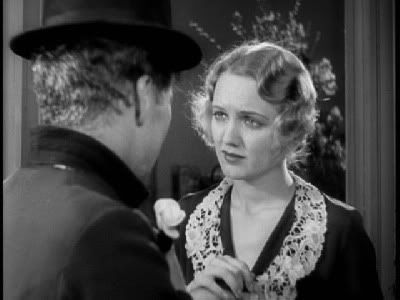
(After the girl pushes the coin into his hands and realizes that her wealthy knight in shining armor is realized in this pathetic figure of the tramp, her expression is as priceless as it is complicated—recognition, pity, compassion, gratitude, and so much more. But certainly not elation, acceptance, anticipation.)

(The final shot which fades to black.)
Even then, in 1931, the genius of Chaplin completely destroys Stranger Than Fiction. If you write a screenplay that stakes the entire film on the final scene, don't confuse an ending with a conclusion. In City Lights, the conclusion of the story lies beyond the diegetic end of the film, the fade to black. What allows Chaplin to stake everything on the final scene and to succeed wildly doing so is that he concludes without conclusion and thus avoids denouement and the classic narrative dichotomy: tragedies end in death, comedies end in marriage. Stranger Than Fiction has the audacity to stake it all on the conclusion, but is not brave enough to avoid denouement.


No comments:
Post a Comment